Article visual
The guide in one frame.
Amanpuri opened in 1988 on a former coconut plantation on Phuket's west coast.
Amanpuri opened in 1988 on a former coconut plantation on Phuket's west coast. Its pitched-roof pavilions and secluded villas became the layout every later Aman resort was built from. Here's how the original still reads today.
Paid partner link - VIAIVE may earn compensation at no additional cost to you.
Most resort brands start with a business plan and a real-estate map.
Aman started with a single property on a single peninsula: Amanpuri, which opened on Phuket's west coast in 1988 as, in the company's own words, "the first Aman 'Place of Peace.'" Every Aman that followed, from Bali to Bhutan to Marrakech, is in some sense a variation on the layout that first appeared here. That layout is a scattering of private, single-storey pavilions connected by raised walkways through the trees, oriented toward water, and built without a conventional hotel's central block. Amanpuri is where that grammar was written, and it remains the clearest place to see it in its original form.
Most resort brands start with a business plan and a real-estate map.
The Pavilion That Started It: How Amanpuri's Architecture Became the Aman Template works best when the specifics above match the trip; when they don’t, use Plan With VIAIVE rather than treating this as a final call.
Paid partner link - VIAIVE may earn compensation at no additional cost to you.
| Decision point | Primary path | Alternative path |
|---|---|---|
| Traveler decision | Most resort brands start with a business plan and a real-estate map. | Use correspondence when the itinerary has constraints the public page cannot resolve. |
| Best use case | Introduction | A coconut plantation, not a cleared site |
| Commercial path | Use disclosed partner modules when public rate windows matter. | Use VIAIVE correspondence when the placement, room category, or routing needs human judgment. |
Amanpuri opened in 1988 on a former coconut plantation on Phuket's west coast.
Most of luxury Bangkok climbs.
Ascott Thonglor Bangkok trades a hotel room for a real apartment — kitchen, washing machine, up to three bedrooms — inside Thonglor's café-and-restaurant district.
Ascott Embassy Sathorn Bangkok's 393 apartments, full kitchens, and Sathorn embassy-district address show what a serviced residence changes about a multi-week Bangkok stay compared to a conventional hotel room.
19 July 2026
VIAIVE verifies current reservation status, chef or programme changes, and neighborhood fit before naming a dining decision.
Disclosed Stay22 partner paths appear once near the close of the guide, with sponsored nofollow labeling and affiliate disclosure.
Amanpuri opened in 1988 on a former coconut plantation on Phuket's west coast. Its pitched-roof pavilions and secluded villas became the layout every later Aman resort was built from. Here's how the original still reads today.
Most resort brands start with a business plan and a real-estate map. Aman started with a single property on a single peninsula: Amanpuri, which opened on Phuket's west coast in 1988 as, in the company's own words, "the first Aman 'Place of Peace.'" Every Aman that followed, from Bali to Bhutan to Marrakech, is in some sense a variation on the layout that first appeared here. That layout is a scattering of private, single-storey pavilions connected by raised walkways through the trees, oriented toward water, and built without a conventional hotel's central block. Amanpuri is where that grammar was written, and it remains the clearest place to see it in its original form.
Most resort brands start with a business plan and a real-estate map. Aman started with a single property on a single peninsula: Amanpuri, which opened on Phuket's west coast in 1988 as, in the company's own words, "the first Aman 'Place of Peace.'" Every Aman that followed, from Bali to Bhutan to Marrakech, is in some sense a variation on the layout that first appeared here: a scattering of private, single-storey pavilions connected by raised walkways through the trees, oriented toward water, deliberately without a conventional hotel's central block. Amanpuri is where that grammar was written, and it's still the clearest place to see it in its original form.
The land Amanpuri sits on was a working coconut plantation before it was a resort, a detail that shaped the design more than any single architectural decision did: the property's builders chose to work around the existing palms rather than clear them. That constraint produced the resort's defining visual signature, pavilions and pathways woven between mature coconut trees on uneven ground, never arranged on a flat, graded site. Aman's own description of the property today still leans on this origin, calling Amanpuri a place "soundtracked by the whispers of coconut palms and the sighs of the Andaman Sea." Four decades on, the trees that dictated the site plan are still standing among the buildings they shaped.
This is a meaningfully different starting point from most beachfront resort construction, where the site is typically leveled and landscaped after the building goes up. At Amanpuri, the vegetation came first and the architecture negotiated with it. The property still reads as a landscape with buildings woven into it, an effect closer to a garden that happens to contain architecture.
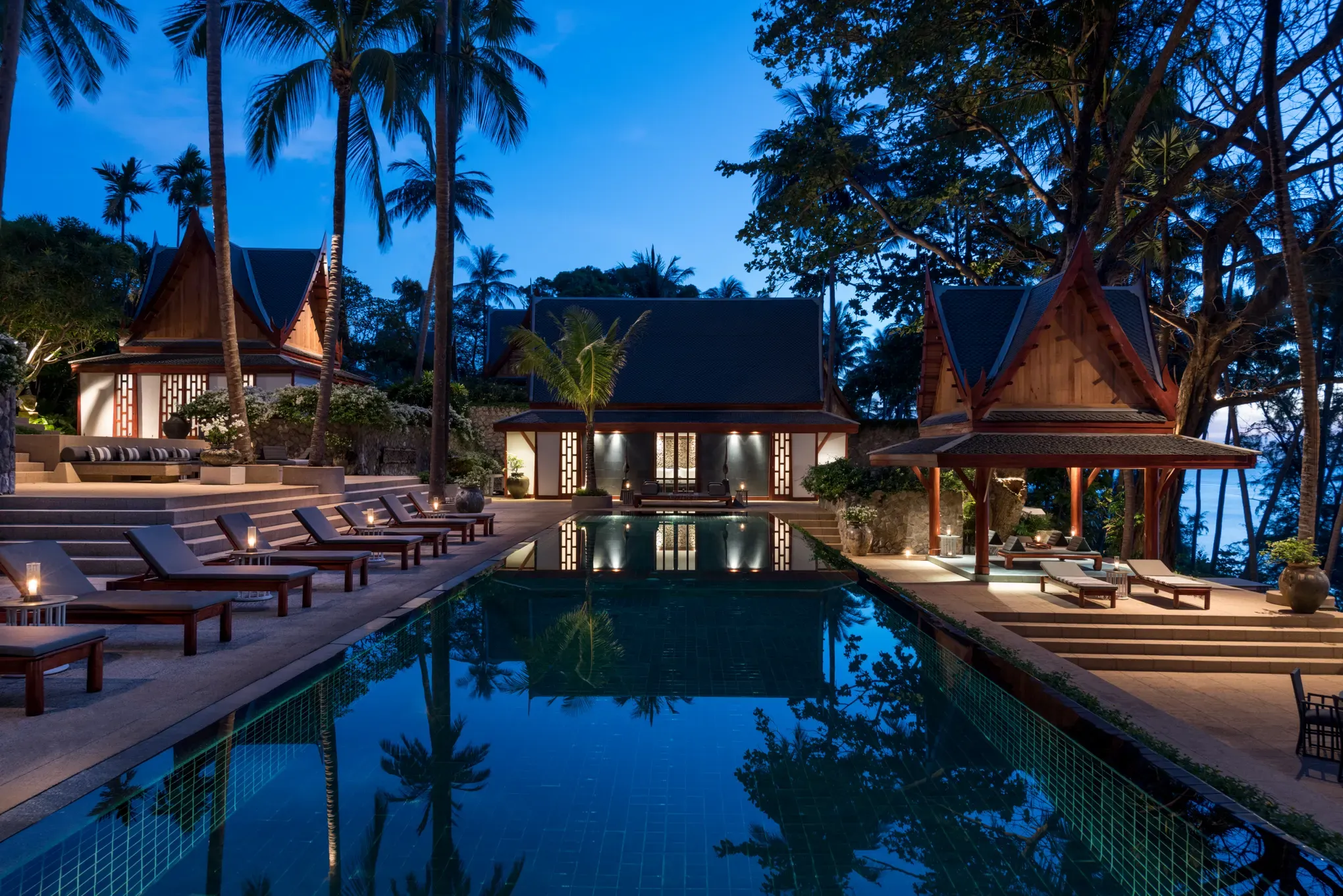
Amanpuri's core architectural move was to abandon the multi-storey hotel block entirely in favor of standalone, single-bedroom pavilions: steep, pitched-roof structures set apart from one another and reached by a network of raised walkways, with no interior corridors at all. Aman's own materials describe the property's pitched-roof structures directly, and the accommodation itself is still organized this way today: the base Pavilion category runs 115 square metres, the four Pool Pavilion variants (Ocean, Garden, Premium Ocean, Deluxe Ocean) each add a private pool at 147 square metres, and a Two-Bedroom Pool Pavilion extends the same format to 262 square metres for two king-bedded parties sharing one terrace.
The pitched roofline draws on traditional Thai temple and teak-house proportions rather than a generic tropical-resort vocabulary, a detail widely documented in architectural histories of the property, alongside the design's roots in the ancient Thai capital of Ayutthaya. Whatever the specific reference points, the effect at ground level is consistent: no pavilion faces directly into another, sightlines run outward toward garden or sea, and the walk from a guest's door to the beach follows a route through planted grounds, never a hotel hallway.
The second half of Amanpuri's layout logic is the separation between Pavilions and Villas. Where the Pavilions sit within the main body of the resort, connected to its restaurants and wellness facilities by the same raised-walkway network, the Villas are pushed to the tip of the peninsula: three- to nine-bedroom private residences, each with its own swimming pool and a resident Thai chef, built for guests who want a self-contained household rather than a hotel room with amenities nearby. Both Ocean Villas (facing the Andaman Sea) and Garden Villas (shaded by coconut palms) follow this same logic of increasing privacy the further a guest moves from the resort's shared spaces.
That two-tier structure, a connected pavilion core plus a separated villa periphery, is the part of Amanpuri's plan that shows up most consistently in later Aman properties, even in climates and terrains nothing like a Thai coconut grove. The specific materials change from resort to resort; the underlying decision to separate "connected but private" from "fully self-contained" does not.
None of this is presented as a claim that Amanpuri is unrepeated or unmatched. Later Aman resorts have made real advances of their own, and several sit on more dramatic terrain. What Amanpuri offers instead is the chance to see the source layout in the place it was first built, on the plantation that shaped it, forty years on. For a traveler weighing Amanpuri against a newer-generation Aman, the honest distinction is this: newer properties often refine the formula for a specific landscape, while Amanpuri is the landscape the formula was written for in the first place. The pavilions are lower, older in spirit, and less dramatic than some of the brand's later, more architecturally ambitious builds, and that's arguably the point. This is the resort other resorts have spent decades quoting.
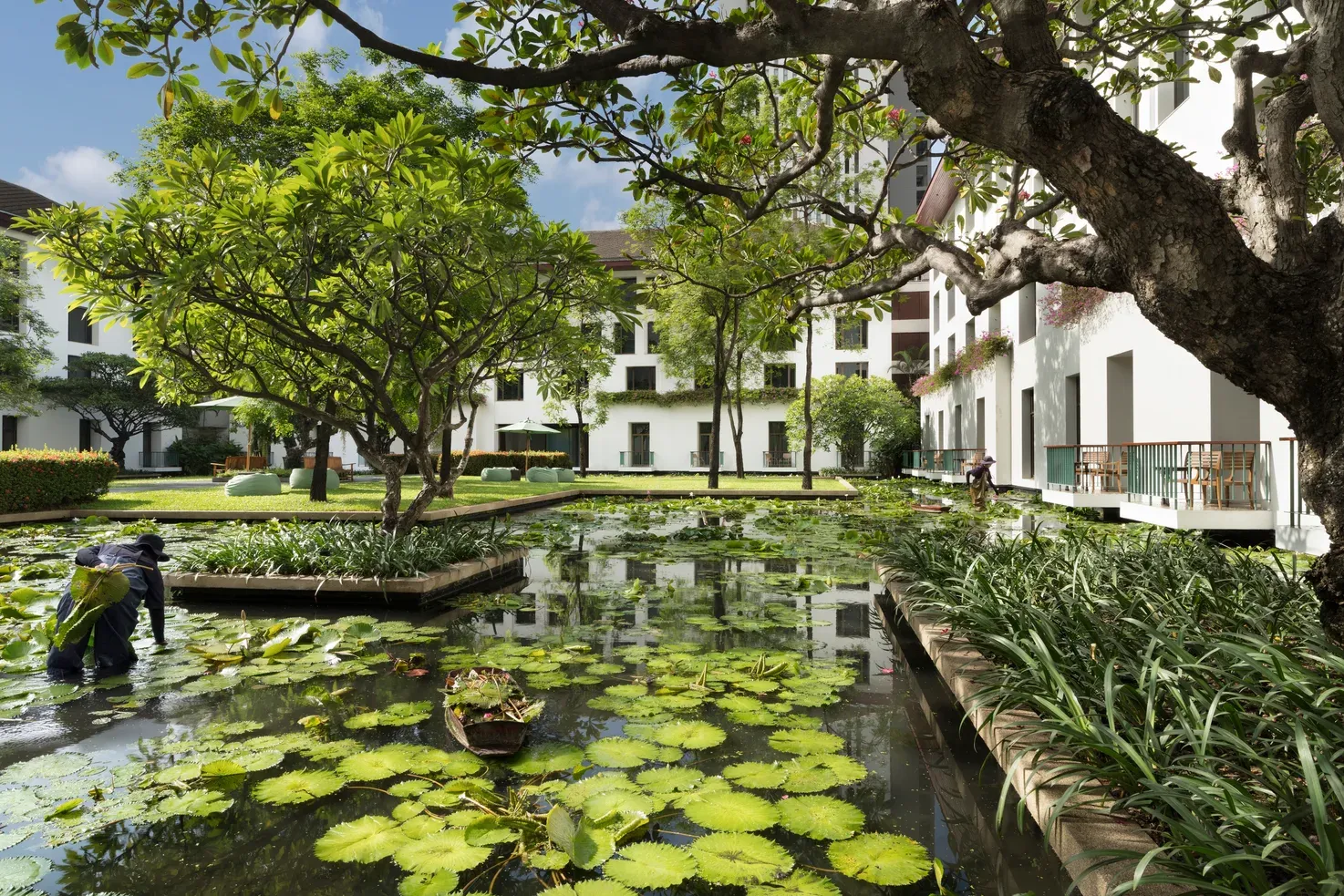
Most of luxury Bangkok climbs. The Sukhothai Bangkok spreads instead — chedis, colonnades and lotus ponds across lush Sathorn grounds. A companion read on why the low-rise, garden-and-pond argument still holds.
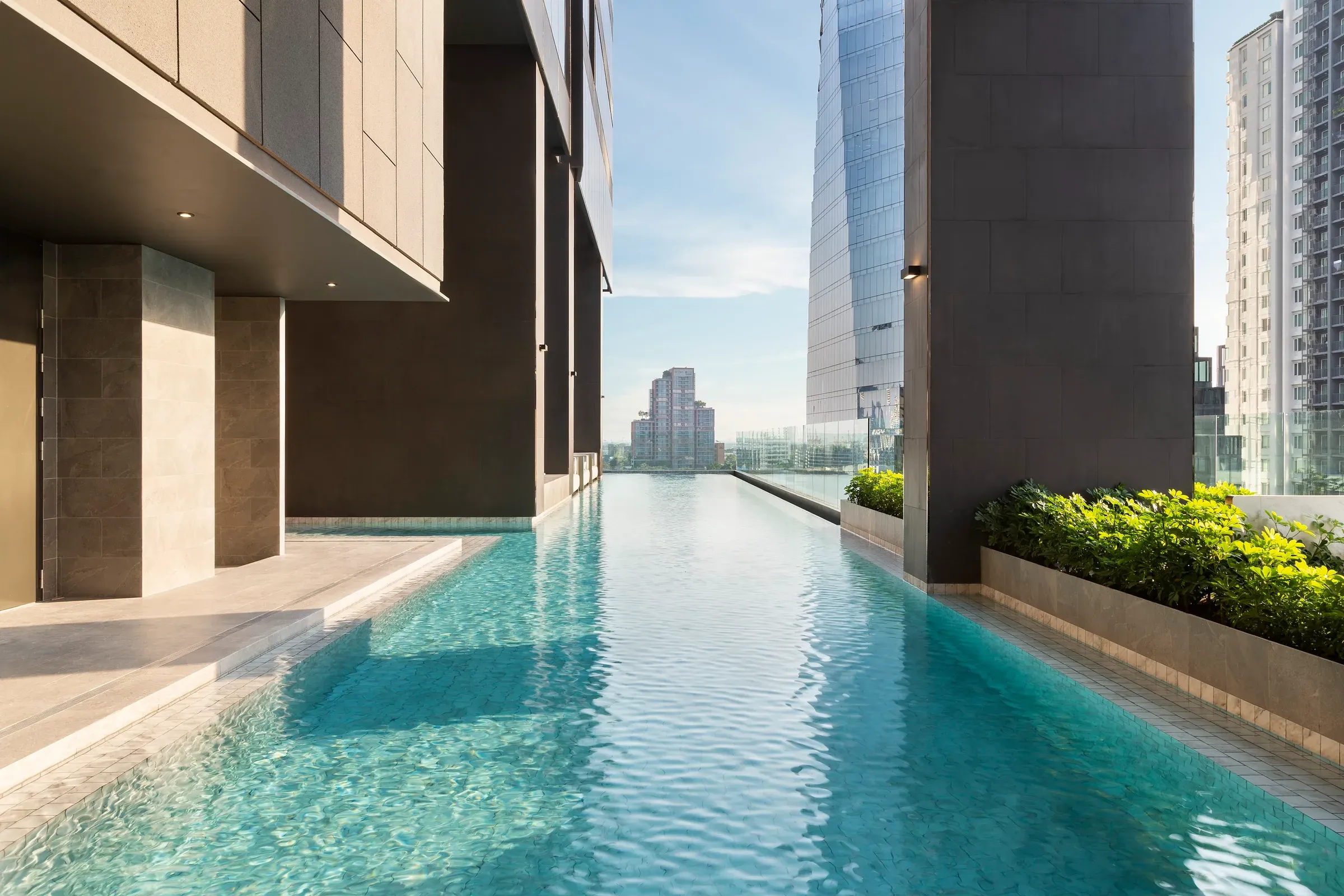
Ascott Thonglor Bangkok trades a hotel room for a real apartment — kitchen, washing machine, up to three bedrooms — inside Thonglor's café-and-restaurant district. Here's why that model changes what a longer Bangkok stay can look like.
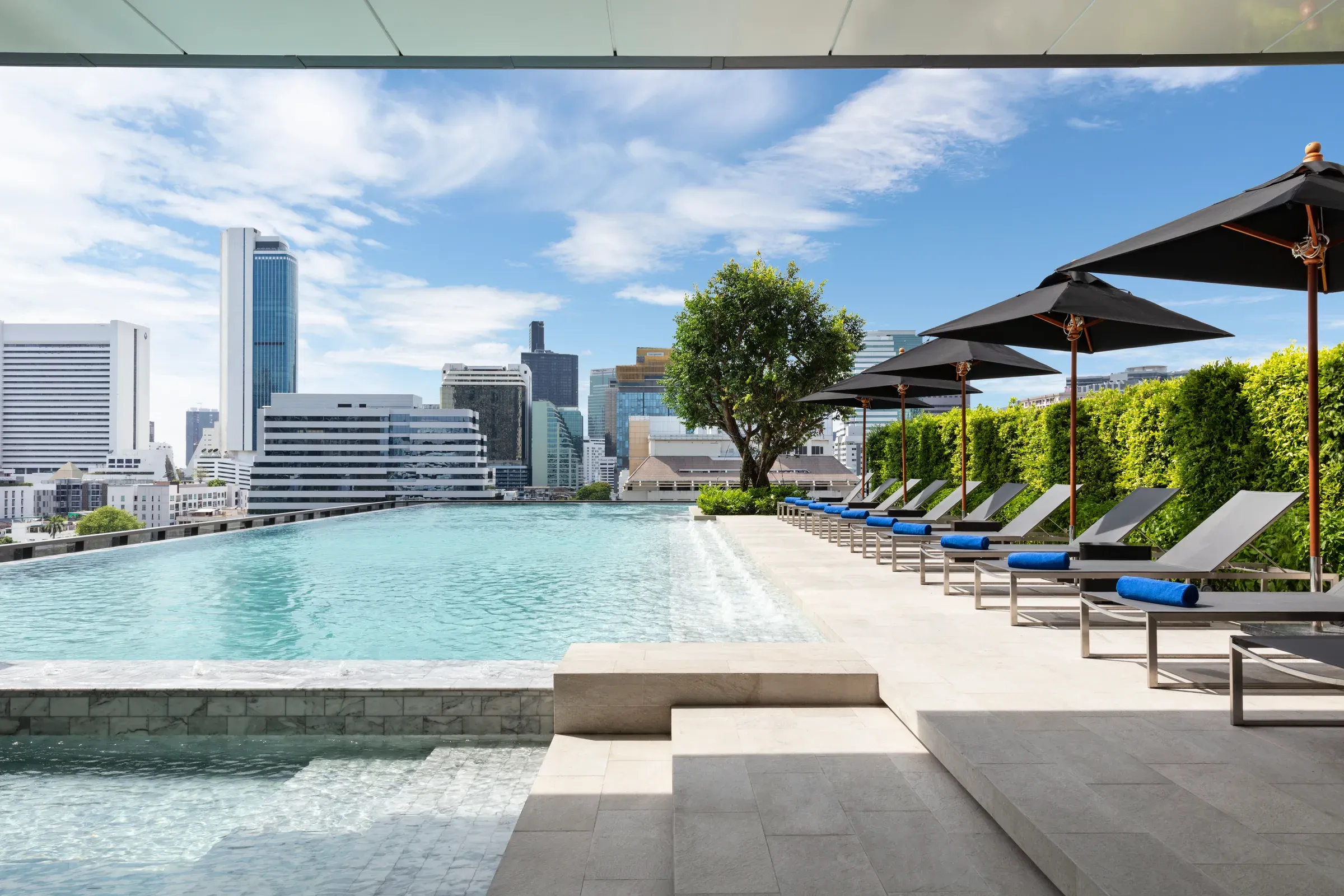
Ascott Embassy Sathorn Bangkok's 393 apartments, full kitchens, and Sathorn embassy-district address show what a serviced residence changes about a multi-week Bangkok stay compared to a conventional hotel room.
Field Intelligence Letter
A short monthly note on hotel openings, route shifts, seasonal timing, and the stay decisions worth making early.
One letter per month. Unsubscribe at any time. No sharing, no resale. Privacy Policy.
When a piece here makes you want to move, write the first few lines.
Plan With VIAIVE ↗