Article visual
The guide in one frame.
Amanoi isn't near Nui Chua National Park — it's built inside its boundary, on a bay that adjoins a marine reserve.
Amanoi isn't near Nui Chua National Park — it's built inside its boundary, on a bay that adjoins a marine reserve. Here's what that address actually does to how a stay unfolds, from the spa's location to the excursions on offer.
Paid partner link - VIAIVE may earn compensation at no additional cost to you.
> VIAIVE note: A lot of resorts advertise a "national park setting" when what they actually mean is a forested hillside somewhere in the same district.
Amanoi's own site makes a more specific claim: the resort sits inside the boundary of Nui Chua National Park and UNESCO Biosphere Reserve, a 29,000-hectare protected area in Ninh Thuan Province, with a marine reserve adjoining its own stretch of Vinh Hy Bay. That's a different claim, and it's worth tracing what it actually changes about the property: not just the view, but where the buildings sit and what a guest can do without leaving the grounds.
> VIAIVE note: A lot of resorts advertise a "national park setting" when what they actually mean is a forested hillside somewhere in the same district.
Inside the Park, Not Beside It: What Amanoi's Núi Chúa Address Actually Changes works best when the specifics above match the trip; when they don’t, use Plan With VIAIVE rather than treating this as a final call.
Paid partner link - VIAIVE may earn compensation at no additional cost to you.
| Decision point | Primary path | Alternative path |
|---|---|---|
| Traveler decision | > VIAIVE note: A lot of resorts advertise a "national park setting" when what they actually mean is a forested hillside somewhere in the same district. | Use correspondence when the itinerary has constraints the public page cannot resolve. |
| Best use case | Introduction | A protected boundary, not a backdrop |
| Commercial path | Use disclosed partner modules when public rate windows matter. | Use VIAIVE correspondence when the placement, room category, or routing needs human judgment. |
Amanoi isn't near Nui Chua National Park — it's built inside its boundary, on a bay that adjoins a marine reserve.
Most of luxury Bangkok climbs.
Ascott Thonglor Bangkok trades a hotel room for a real apartment — kitchen, washing machine, up to three bedrooms — inside Thonglor's café-and-restaurant district.
Ascott Embassy Sathorn Bangkok's 393 apartments, full kitchens, and Sathorn embassy-district address show what a serviced residence changes about a multi-week Bangkok stay compared to a conventional hotel room.
19 July 2026
VIAIVE verifies current reservation status, chef or programme changes, and neighborhood fit before naming a dining decision.
Disclosed Stay22 partner paths appear once near the close of the guide, with sponsored nofollow labeling and affiliate disclosure.
Amanoi isn't near Nui Chua National Park — it's built inside its boundary, on a bay that adjoins a marine reserve. Here's what that address actually does to how a stay unfolds, from the spa's location to the excursions on offer.
> VIAIVE note: A lot of resorts advertise a "national park setting" when what they actually mean is a forested hillside somewhere in the same district. Amanoi's own site makes a more specific claim: the resort sits inside the boundary of Nui Chua National Park and UNESCO Biosphere Reserve, a 29,000-hectare protected area in Ninh Thuan Province, with a marine reserve adjoining its own stretch of Vinh Hy Bay. That's a different claim, and it's worth tracing what it actually changes about the property: not just the view, but where the buildings sit and what a guest can do without leaving the grounds.
> VIAIVE note: A lot of resorts advertise a "national park setting" when what they mean is a forested hillside somewhere in the same district. Amanoi's own site describes something more specific: the resort sits inside the boundary of Nui Chua National Park and UNESCO Biosphere Reserve, a 29,000-hectare protected area in Ninh Thuan Province, with a marine reserve adjoining its own stretch of Vinh Hy Bay. That's a different claim, and it's worth tracing what it actually changes about the property: not just the view, but where the buildings sit and what a guest can do without leaving the grounds.
Most coastal resorts treat a national park as scenery: something visible from a terrace, reachable by a day-trip van. Amanoi's own materials describe the opposite relationship: the resort is a gateway property built into the edge of Nui Chua National Park itself, an area recognized by UNESCO in 2021 and described by Aman as encompassing 14 tropical ecosystems, from knitted forest to coral-rich sea to cactus-studded semi-desert, with roughly 1,500 plant species and 756 animal types recorded across the park. That density of ecosystem is the reason the resort's excursion list reads less like a spa hotel's activity sheet and more like a park visitor center's: guided treks to Bai Da and Goga Peak, a full-day 21-kilometre trek over King Mountain from Da Hang village with lunch, a porter, and a guide included, and a shorter waterfall trek to Ba Tang with a swimming stop and a picnic overlooking rice fields. None of that requires transferring to a different property or booking a third-party tour operator. It runs directly through Amanoi's own program because the trailheads start close to where the resort already sits.
The same logic extends into the water. Vinh Hy Bay, which the resort overlooks, adjoins a marine reserve that Amanoi's site describes as home to more than 350 varieties of coral, among them staghorn, plate, and brain coral, plus hawksbill and green sea turtles, including nesting activity at Bai Thit Beach. Snorkeling tours and glass-bottom kayaking run out from the resort onto that same reef, and the day and night catamaran excursions the property runs cover swimming coves, snorkeling stops, and, after dark, starlight fishing across the same bay. A guest doesn't drive to a marine park; the marine park is what the bay in front of the resort already is.
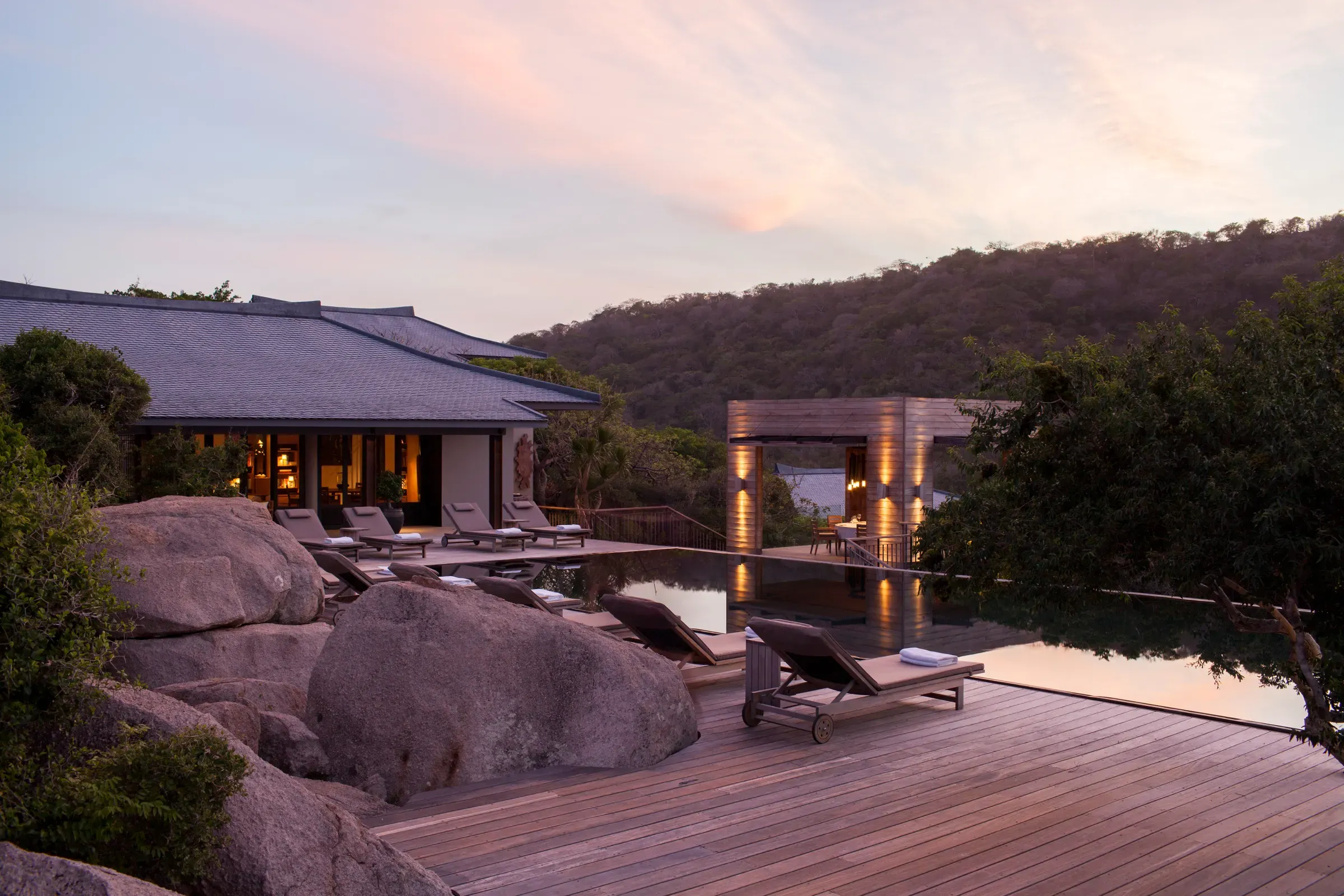
The park setting also explains a detail that's easy to miss on a first look at the property: Amanoi's wellness facilities are not clustered with the guest pavilions on the ridge above the bay. The Aman Spa sits on the shore of a separate lotus-covered lake, with a Yoga Pavilion built directly on that lake for daily classes, while the resort's pool and restaurant sit up on the clifftop with the ocean-facing accommodation. That's a real geographic split, not a design flourish: the property is laid out across the terrain it occupies rather than folded into one wing, so a guest moving between a treatment and dinner is genuinely walking, or being driven, between a lake, a cliff edge, and a beach, never down a single hotel corridor.
The two Wellness Pool Villas make the same point at a smaller scale. The Lake Wellness Pool Villa sits, per the resort's own description, "perched on the edge of a lotus-covered lake across from the Aman Spa," with its own 15-metre pool, a modern hammam, steam room, and cold plunge. The Forest Wellness Pool Villa sits apart from it entirely, with "tranquil views of the hills" and a timber-clad banya in place of the hammam. Aman built two distinct wellness villas, each set in a different micro-setting within the same park boundary, each with its own dedicated therapist. That's only a coherent decision if the surrounding landscape actually offers two distinct settings to put them in, which, inside a 29,000-hectare biosphere reserve, it does.
The practical effect of all this is that Amanoi rewards a guest who wants the park and the bay to be the point of the trip, not a scenic extra layered onto a beach stay. The trekking, the reef, the turtle nesting beach, and the Cham heritage sites nearby (the Cham Museum and the 12th–13th-century Po Klong Garai Towers) are all real, bookable parts of the resort's own program, not add-ons requiring a separate operator. That also means the property asks more of a guest logistically than a beach resort with a single central building: getting from a pavilion to the spa, the beach, or a private dining setup at the Rock Studio means moving across the site the resort was built into, roughly 75 minutes by road from the nearest airport and about 5 hours from Ho Chi Minh City. For a traveler who wants the destination itself, the park, the reef, the bay, to be the reason for the stay, that trade-off is the whole appeal. For a traveler who wants everything within a two-minute walk of the room, it's worth knowing in advance rather than discovering on arrival.
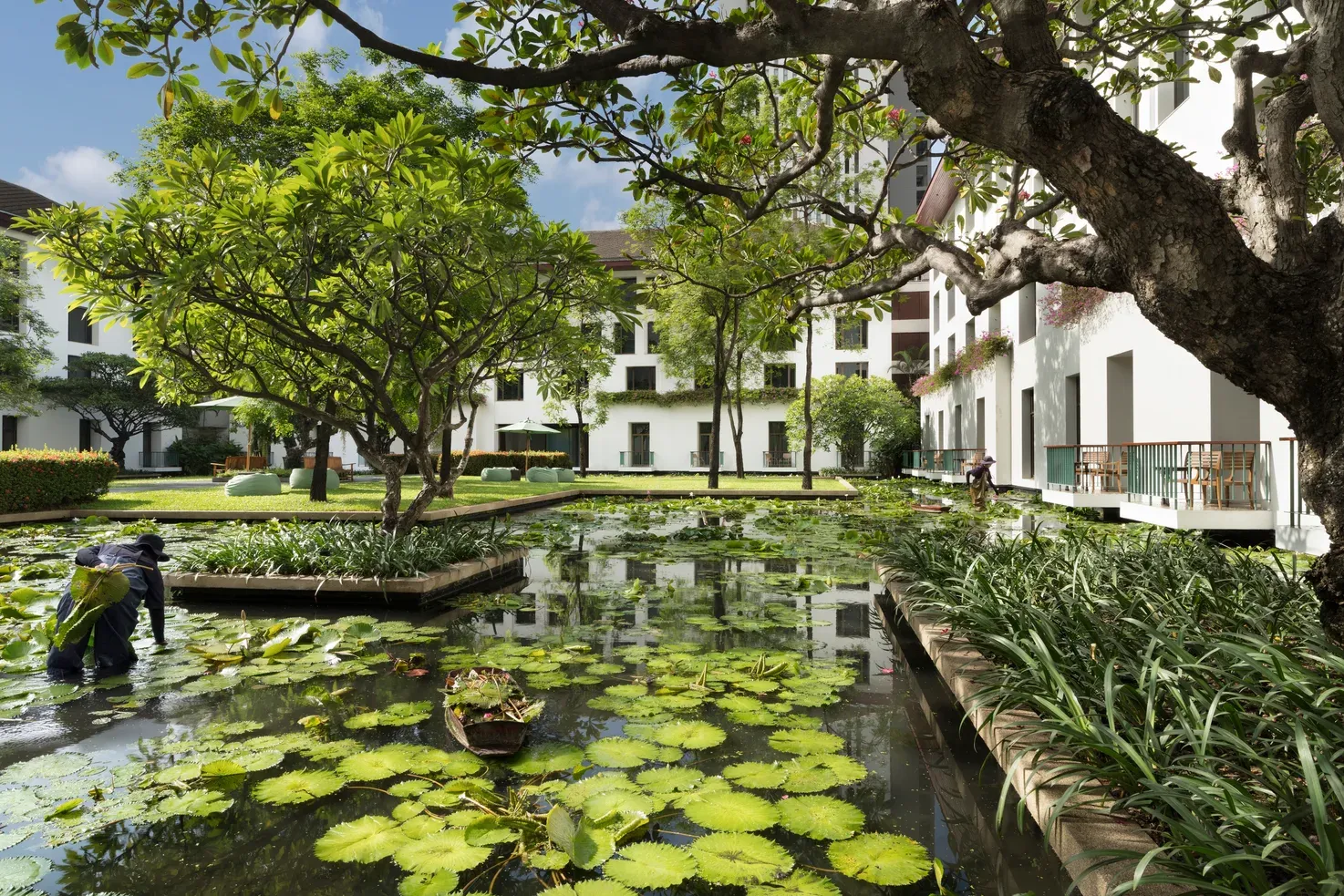
Most of luxury Bangkok climbs. The Sukhothai Bangkok spreads instead — chedis, colonnades and lotus ponds across lush Sathorn grounds. A companion read on why the low-rise, garden-and-pond argument still holds.
Ascott Thonglor Bangkok trades a hotel room for a real apartment — kitchen, washing machine, up to three bedrooms — inside Thonglor's café-and-restaurant district. Here's why that model changes what a longer Bangkok stay can look like.
Ascott Embassy Sathorn Bangkok's 393 apartments, full kitchens, and Sathorn embassy-district address show what a serviced residence changes about a multi-week Bangkok stay compared to a conventional hotel room.
Field Intelligence Letter
A short monthly note on hotel openings, route shifts, seasonal timing, and the stay decisions worth making early.
One letter per month. Unsubscribe at any time. No sharing, no resale. Privacy Policy.
When a piece here makes you want to move, write the first few lines.
Plan With VIAIVE ↗